When thinking about developing a creative practice, many often begin by identifying themselves with a particular discipline. We might think of ourselves as painters, photographers, writers, sculptors, musicians, or designers. We spend time developing our skills, learning the conventions of a medium, and finding ways to make work that feels distinctly our own.
There is tremendous value in that kind of focus. Developing mastery in a particular discipline takes time, curiosity, and a willingness to stay with something long enough to understand its nuances and possibilities. But I think there is another question worth considering, particularly as we explore more complicated ideas or experiences through our work:
What am I trying to communicate, and what creative language will allow me to communicate it most effectively?
That question can lead us somewhere quite different from simply asking what we want to make.
The value of a multidisciplinary creative practice
Some artists are deeply drawn to one discipline. They may spend decades exploring the possibilities of painting, photography, sculpture, or another medium, continually discovering new ways to work within it. Others find themselves naturally moving between disciplines.
Neither approach is inherently better. The important thing is understanding how you tend to think, what interests you, and where your creative instincts lead.
I have always been drawn to multiple forms of creative expression. Writing informs my visual art, and visual art informs my writing. Teaching, research, performance, and journalism have all become part of the same larger creative practice. I don't experience these as separate interests. More often, they feel like different ways of thinking about and communicating ideas.
For a long time, I found this difficult to reconcile with the expectation that an artist should establish a recognizable identity within one, or maybe two, disciplines. There’s nothing wrong with specialization, but I eventually realized that trying to fit myself into a single category would mean setting aside a significant part of the way I naturally work.
A multidisciplinary practice doesn't necessarily mean trying to master everything at once, either. It can mean developing considerable expertise in particular areas, while remaining open to learning and working in others. The center of a creative practice may also change over time, depending on the life season. For many years, visual art and education occupied much of my creative attention. Writing has become a much larger part of that practice in recent years.
If you find yourself moving between disciplines, it may be worth considering whether that movement is actually a distraction from your work, or an important part of how you approach it. And, if you are happiest working within one medium, there is no reason to feel that you need to expand beyond it.
The goal isn't to adopt a particular kind of creative identity. Rather, it's to understand and work with your own.
Finding the throughline
One of the challenges of working across multiple disciplines is that it can be difficult to see how everything fits together. If you paint, write poetry, teach, and conduct research, for example, what connects those activities? What makes them part of a coherent creative practice rather than a collection of seemingly unrelated interests?
I encourage those I work with (and myself!) to look for a throughline.
A throughline is the underlying question, interest, or motivation that connects different areas of your work. It doesn't have to be a single subject or a clearly defined mission. It may be a particular way of looking at the world, a recurring concern, or something you find yourself returning to across different projects.
My own approach tends to be nonlinear. I often begin by looking at the larger picture, noticing relationships between things that initially seem unrelated. I think of it a little like looking through a telescope at a field of stars. First, I see the larger constellation. Then I begin drawing lines from one star to another, gradually recognizing patterns and relationships before bringing individual areas into sharper focus.
I don't always begin a project knowing exactly what I want to make, especially when it comes to creative work, such as a poem or a painting. Sometimes I begin with the sense that there is something I don't understand yet, something that needs to be articulated, or something happening that other people may not be seeing.
Over time, I've recognized a fairly consistent throughline in my own work: I am drawn to things that are complicated, overlooked, misunderstood, hidden, or difficult to articulate. I tend to respond by investigating them and trying to make them visible, understandable, or meaningful through words, images, teaching, and other forms of creative communication.
That underlying interest connects work that might otherwise appear quite different from the outside.
You may find a similar pattern in your own creative practice. Perhaps you return repeatedly to questions of memory, identity, place, relationships, or the natural world. Or, you're interested in the ways people interact with their environments, or in making visible something that is usually overlooked. The subject matter may change, but the questions beneath it can remain consistent.
Recognizing that throughline can help you make sense of your work without requiring you to limit yourself to a single medium or subject.
Mastery isn't always confined to a medium
When we talk about artistic mastery, we tend to think about technical proficiency within a particular discipline. We might consider someone's command of color, composition, perspective, materials, language, musical structure, or performance.
Those skills matter. But when we work across disciplines, there are other forms of mastery worth recognizing.
Observation, inquiry, research, interpretation, synthesis, pattern recognition, and an understanding of audience all move between creative forms. So does the ability to recognize what needs to be communicated and determine how best to communicate it.
These skills can become the foundation of a larger creative practice.
For example, an artist who spends years learning to observe subtle differences in color, texture, and visual relationships may bring that same attentiveness to their writing. A writer accustomed to examining the relationships between individual details and a larger narrative may approach a visual composition with a similar understanding of structure. An educator who has spent years translating complicated information into accessible lessons may bring that experience to journalism, public speaking, or community-based art.
The individual disciplines still require their own knowledge and skills. But the thinking that supports creative work doesn't necessarily stay within disciplinary boundaries.
This is one reason I think it's useful to pay attention to what we learn from one form of creative expression and how that knowledge might inform another.

Choosing the right creative language
Once you have a better understanding of what you're trying to explore or communicate, you can begin thinking about the form your work might take.
Rather than starting with the question, "What medium should I work in?" try asking:
What am I trying to communicate, and what does this particular idea need?
Consider a few questions:
What am I trying to communicate? Is it an emotion, an experience, a memory, a question, information, or a larger social issue?
Who is the intended audience? What do they already know, and what might they need to understand?
What kind of response am I hoping to create? Understanding, empathy, curiosity, recognition, discomfort, reflection, or perhaps a new question?
What can this medium communicate particularly well?
What might be difficult to communicate through this medium?
What might happen if I explored the same idea through another form?
Different creative languages have different possibilities. They also have different limitations. Understanding those differences can help us make more intentional decisions about our work.
Visual art: Communicating beyond words
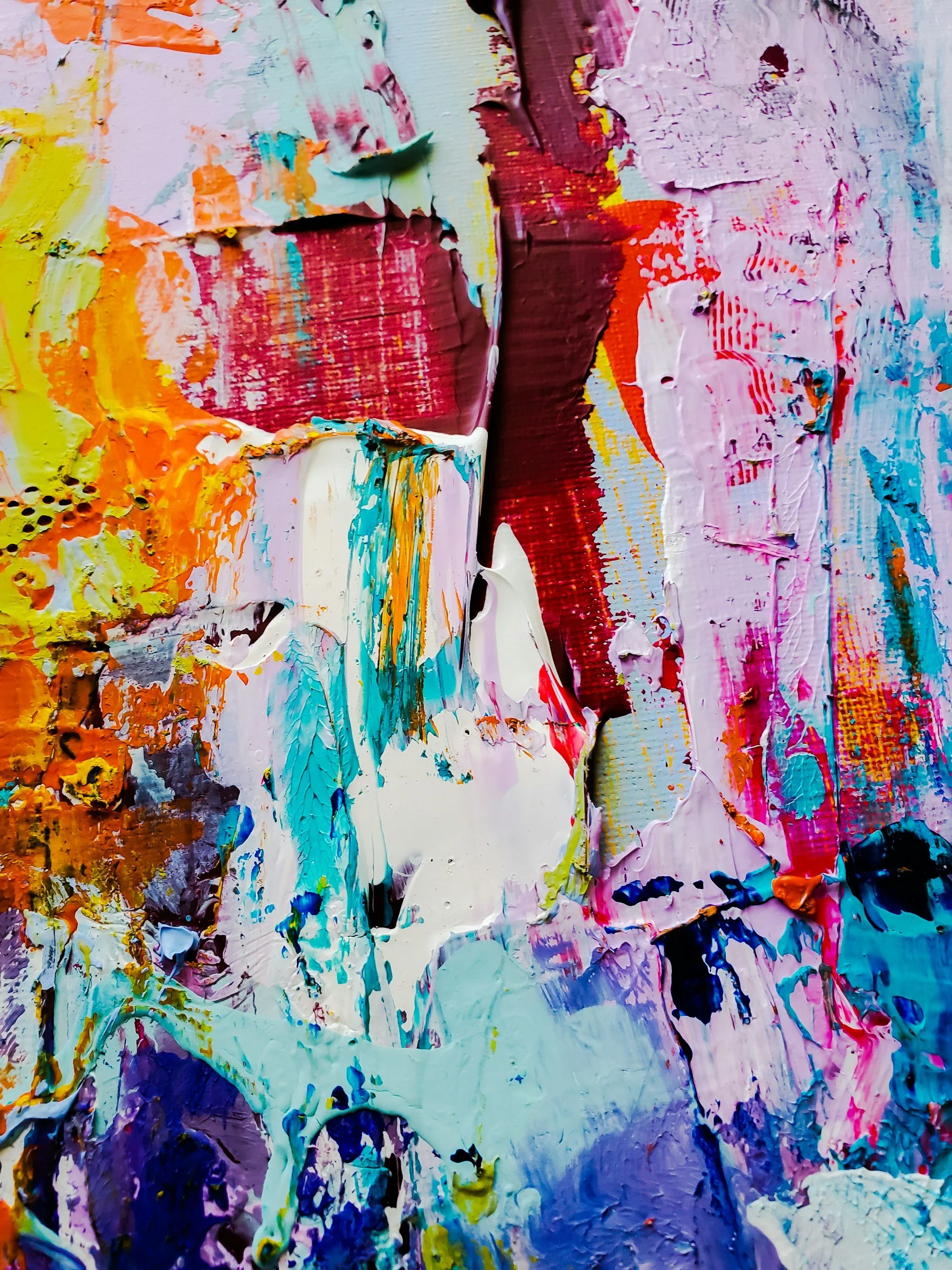
Visual art can communicate through color, texture, composition, material, surface, gesture, and visual metaphor. It can offer a way to explore experiences that may be difficult to articulate verbally.
Sometimes we understand an experience emotionally or intuitively before we have the language to explain it. In those situations, visual art can provide a place to work through the experience without requiring a fully formed verbal interpretation.
In my own abstract painting and collage work, I often begin without preliminary sketches or a clear idea of what the finished piece will look like. The work develops through an ongoing exchange with materials, color, texture, and surface, with the previous action or choice informing the next. I make decisions, respond to what is happening, and discover possibilities I couldn't necessarily have anticipated at the beginning.
The act of making isn't simply an illustration of an idea I already understand. Sometimes, making the work is how I come to understand the idea in the first place.
Visual art can also leave room for ambiguity. A viewer may bring experiences, associations, and interpretations to a piece that differ considerably from the artist's original intentions. I don't necessarily consider that a failure of communication. In some forms of visual art, those layers of meaning (I like to call “meaning stacking”) are part of what makes the work interesting.
Poetry: Finding the larger idea in a compressed moment
Poetry offers another kind of possibility. It can compress a considerable amount of meaning into a relatively small space, often using a particular image, memory, or moment as a starting point.
A poem might begin with something very specific: an afternoon in childhood, a particular landscape, a conversation, or a fleeting observation. From there, it can move toward much larger questions about memory, identity, relationships, change, or the human experience.
I think about this when I consider my poem Season, which begins with a particular snapshot of being a preteen. The landscape and weather help establish that moment, but the poem gradually expands into questions about growing up, social pressures, relationships, and the experience of losing a dear friend.
The particular moment becomes a lens through which something much larger can be explored.
Sometimes the most powerful way to communicate a large idea is to make the frame smaller.

Journalism: Providing clarity and context
Journalism can serve a different purpose. When I write about disability, accessibility, the arts, or other subjects that may be unfamiliar to readers, I want to provide clear information, context, evidence, and multiple perspectives.
The challenge is to take something complicated and make it understandable without flattening the subject or sacrificing important details.
I often think of this as providing a prismatic view of an issue. Rather than presenting one flat perspective, I want readers to see its different facets: the experiences of the people involved, the broader context, the systems or circumstances influencing the situation, and the questions that may not have obvious answers.
My role isn't necessarily to tell readers what to think. It's to give them enough information and context to think critically for themselves.
This is quite different from what I might want to accomplish through an abstract painting or a poem. In those forms, ambiguity and individual interpretation can be productive. In journalism, clarity is essential.
Neither approach is inherently more sophisticated; they serve different purposes.

Creative nonfiction: When lived experience matters
A personal essay can bring a reader into an experience in a way that might feel less immediate through fiction or more traditional reporting. It allows the writer to communicate not only what happened, but what it felt like and what the experience came to mean.
That doesn't mean a personal essay is simply a chronological account of events. Like other forms of writing, it requires selection, structure, voice, point of view, and an understanding of what the piece is ultimately trying to communicate.
In my essay Dream Home(less), I draw on an experience of being a child without a home for a period of time following severe weather. The essay explores displacement and the meaning of home, including the ways we sometimes have to create a sense of home in circumstances that look very different from what we imagined.
The lived experience gives the essay a particular intimacy, allowing me to focus on the details that matter most to the larger theme I’m striving to convey.
One of the most powerful effects of personal essays, I feel, is the potential for connection through shared or related experiences. There are times when sharing a personal experience can help another person feel less alone, or give readers a more tangible understanding of something they may otherwise encounter only as an abstract concept.
Fiction: Creating an encounter with another person's experience
Fiction offers yet another possibility: the opportunity to spend extended time inside another person's consciousness.
A reader may spend hundreds of pages alongside a character, experiencing what that person notices, fears, remembers, misunderstands, and eventually comes to understand. That sustained attention can create a particular kind of intimacy.
I often turn to fiction when I want to explore psychological interiority, personal transformation, and the ways people make meaning of difficult experiences. Research into historical events, cultural shifts, and sociological trends may inform the work, but the story allows readers to encounter those larger subjects through the lives of individual characters.
Statistics can tell us how many people are affected by an issue, and research and journalism can help us understand its context. But, fiction can ask us to experience the world from inside another person's perspective for an extended period of time.

Performance, education, and voice
Some ideas need to unfold over time. Performance-based work introduces time as another dimension of the audience's experience. What happens, when it happens, and how the audience encounters the work can all become part of its meaning.
Education is another form of creative communication. Teaching and curriculum design involve taking complicated ideas and making them accessible to people with different levels of familiarity, experience, and prior knowledge.
Voice and narration can also create new pathways into information and creative work. An audio description or narrated exhibition tour, for example, can make visual information available to someone who cannot access it in the same way as a sighted visitor. An audiobook allows a written work to be experienced through listening.
These forms aren't interchangeable. Each offers something different, and sometimes combining them allows an idea or experience to reach an audience in ways that a single medium cannot.

What changes when we translate an idea into another medium?
One of the more interesting exercises we can undertake as artists is to imagine translating the same experience or idea into several different forms.
What would it look like as a painting? What might it become as a poem? How would we approach it in a journalistic article, a personal essay, a fictional story, or a performance?
The result wouldn't simply be the same content presented in different packaging.
A painting isn't a poem with colors., and a poem isn't a journalistic article broken into lines. Nor is a novel isn't journalism with fictional names. Each medium has its own grammar, conventions, and possibilities.
When we move an idea from one form to another, some things may be lost. Others may become newly visible. A painting might communicate a feeling that is difficult to explain in words. A poem might connect a specific memory to a much larger idea. A journalistic article might provide context and evidence that neither the painting nor the poem could offer. A fictional story might invite a reader to experience the emotional interior of a situation.
The act of translation changes what can be communicated.
This is worth exploring even if you have no intention of becoming multidisciplinary. Trying to approach an idea through another form can reveal something about the limitations and possibilities of the medium you already know well.
A few questions to take into your own creative practice
You don't need to abandon your preferred discipline or work across multiple forms to benefit from this way of thinking. You might simply approach your next project with a little more curiosity about the relationship between the idea and the medium.
Here are a few questions to consider:
1. What am I trying to communicate?
Move beyond the initial description of the project. What is the question, experience, emotion, or idea underneath it? What has captured your attention, and why?
2. What does this particular medium make possible?
Consider what your chosen form does especially well. Does it allow you to communicate through sensation, language, narrative, time, material, or direct experience? What might be difficult to express through it?
3. Who am I trying to reach?
Think about what your audience already knows and what they might need from the work. Are you trying to communicate with people who share your experiences, introduce an unfamiliar subject, create empathy, or invite a different perspective?
4. What kind of encounter do I want to create?
Do you want someone to understand something, feel something, recognize an experience, question an assumption, or see a familiar subject differently? You don't necessarily need to provide an answer. Sometimes creating a meaningful question is enough.
5. Am I choosing this medium because it is appropriate for the idea, or simply because it is the one I most readily associate with myself?
There is nothing wrong with working within the forms you know and love. But it can be useful to recognize when familiarity is guiding a decision that might benefit from a little more exploration and creative risk.
Let the idea tell you what it needs
Not everyone needs to become a multidisciplinary artist. Some people find their greatest creative fulfillment through years of focused exploration within a single discipline. Others may discover that their interests, experiences, and ways of thinking naturally lead them across several forms. What matters is giving yourself the agency to recognize the difference and work with your natural operating mode.
Our creative identities can change. The mediums we work in can change. Even the questions that motivate us can shift as we move through different seasons of life. That doesn't mean the work lacks direction or coherence.
Sometimes, the connection between different projects isn't immediately apparent. It may take time to recognize the underlying questions that have been guiding us all along.
I often think about the experience of finishing a particularly good book. We often finish, feeling that something has shifted—that we have been changed, or at least rearranged, even in a small way.
That's the kind of encounter I hope to create through my own work, regardless of the medium.
Perhaps the most useful question we can bring to a creative project isn't what we should make, or even what we should call ourselves as artists. It's:
What is difficult to see, understand, articulate, or experience, and what creative language might allow me to illuminate it?